Loading...
Searching...
No Matches
topoi.cppm File Reference
module dedekind.category
The Internal Logic of the Topos. More...
#include <concepts>#include <functional>#include <type_traits>#include <utility>import dedekind.category:lattice;
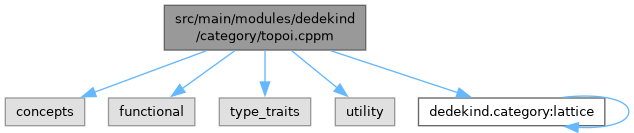
Include dependency graph for topoi.cppm:
Namespaces | |
| namespace | dedekind::category |
Concepts | |
| concept | dedekind::category::IsClassifierConstant |
| concept | dedekind::category::IsPredicate |
| The Predicate Morphism: the DSL's membership test, i.e. the characteristic arrow \(\chi_A : A \to \Omega\). | |
| concept | dedekind::category::IsCharacteristic |
| Categorical alias for a Predicate mapping to Ω: the characteristic arrow \(\chi_A : A \to \Omega\) that classifies a subobject (a set). | |
| concept | dedekind::category::IsDecidableCharacteristic |
The Boolean refinement of IsCharacteristic: a membership test valued in the dominance Σ, i.e. \(\chi_A : A \to \Sigma\) with \(\Sigma = \Omega\)-decided \(= @c bool\). | |
| concept | dedekind::category::IsDominanceInclusion |
| The Rosolini inclusion arrow \(\iota : \Sigma \hookrightarrow
\Omega\): a map between truth-objects out of the decided fragment. | |
| concept | dedekind::category::IsSieve |
| Signature-level witness for a sieve of arrows into an object. | |
| concept | dedekind::category::IsGrothendieckTopology |
| Signature-level witness for Grothendieck coverage rules over sieves. | |
| concept | dedekind::category::IsBundleProjection |
| A projection morphism π : E -> B for a bundle candidate. | |
| concept | dedekind::category::IsFiberBundle |
| Signature-level witness for a fiber bundle over a base species. | |
| concept | dedekind::category::IsSubobject |
| The categorical witness of a monomorphism ι: S ↣ A — a characteristic morphism χ: A → Ω together with its inclusion. | |
| concept | dedekind::category::IsLSet |
An L-set: a subobject of a carrier with \(\chi : X \to L\) into a named bounded chain \(L\) (Codomain = L::Ω). The carrier is asked for copies (std::semiregular), not for a decidable ==: the equality of sets is the Rice cycle (#970), not a trait of the carrier, so the relations of a hom-set are a carrier too (𝔸<RelExpr>, #1045). An ETCS set asks decidable equality itself (IsSet, whose classifier construction needs it), as IsArrow asks an archetype of its domain rather than a value type (archetype_t). Pst is asked of the species (an Ockham algebra whose Ω is totally ordered), not of the bare Ω, so a Chain<int> set (Ω = int) qualifies while a bare int never does. The chain is the registered total order (IsTotalOrder: reflexive, transitive, antisymmetric, comparable), not the syntactic std::totally_ordered, so an Ω without certified order laws (a raw float, whose NaN breaks reflexivity) is refused honestly. | |
| concept | dedekind::category::IsFiniteChain |
A carrier that is a finite chain by its representation: totally ordered and either a machine integer or an enumeration (both finite by construction). bool, Ternary, int qualify; Cardinality and the dense carriers do not. | |
| concept | dedekind::category::IsFiniteLSet |
The Pst fragment: an L-set whose carrier is a finite chain (IsFiniteChain), so χ is a finite table and normalisation by evaluation is complete. Products of finite chains follow with IsProduct. | |
| concept | dedekind::category::IsQuotient |
The categorical witness of a regular epimorphism q: A ↠ Q — the dual of IsSubobject. | |
| concept | dedekind::category::IsPredicatePair |
Two predicates over one object, answering in one species: the operand sort of the predicate combinators below, which close on IsPredicate. Named so the set grammar's && / || (sets) can take exactly the other pairs of terms (relational fragments, mixed terms, the structured collapse) without overlapping these. | |
Typedefs | |
| template<typename A, typename L = Boole> | |
| using | dedekind::category::PowerObject = Exponential<A, typename L::Ω> |
| Power Object Alias. | |
Functions | |
|
template<typename OmegaTarget, typename L, typename Constant> requires std::same_as<std::remove_cvref_t<Constant>, OmegaTarget> || requires(const std::remove_cvref_t<Constant>& c) { { lift_logic<L>(c) } -> std::same_as<OmegaTarget>; } | |
| constexpr auto | dedekind::category::lift_classifier_constant (Constant value) |
Lift a classifier constant into a predicate's Ω: the identity when it is already there, else the dominance lift lift_logic into the predicate's species L (true into Ternary, Ternary::Unknown into Percentage, true onto Chain<int>'s top, ...). The species is passed, not read off OmegaTarget, so a species-tagged predicate whose Ω is no truth object on its own (int) still lifts. Constrained, so a pair with no registered embedding fails the combinators' gate, not this body. | |
|
template<typename A, typename F> requires (!IsArrow<std::remove_cvref_t<F>>) && std::invocable<std::decay_t<F>, const A&> && IsΩ<std::invoke_result_t<std::decay_t<F>, const A&>> | |
| constexpr auto | dedekind::category::classify (F f) |
| Characteristic Morphism Factory (classify) Returns the Subobject Species (The Body) carrying the rule (The Arrow). | |
| template<typename F> requires (!IsArrow<std::remove_cvref_t<F>>) && requires { typename signature_extractor<std::decay_t<F>>::type; } && IsΩ<codomain_t<std::decay_t<F>>> | |
| constexpr auto | dedekind::category::classify (F f) |
| Domain-inferring classify: deduces A from the callable's signature. | |
|
template<typename A, IsArrow F> requires IsPredicate<F> && std::same_as<Dom<F>, A> | |
| constexpr auto | dedekind::category::classify (F f) |
| Idempotent classify: Passthrough for existing Arrows. | |
| template<typename P, typename Q> requires IsPredicatePair<P, Q> | |
| constexpr auto | dedekind::category::operator&& (P p, Q q) |
| Logical Conjunction (Intersection): Synthesizes a rule for A ∩ B. | |
|
template<IsClassifierConstant C, IsPredicate P> requires (!IsPredicate<std::remove_cvref_t<C>>) && requires(C c) { lift_classifier_constant<Cod<P>, predicate_logic_t<P>>(c); } | |
| constexpr auto | dedekind::category::operator&& (C constant, P p) |
| Conjunction of a constant logical value with a predicate. | |
|
template<IsPredicate P, IsClassifierConstant C> requires (!IsPredicate<std::remove_cvref_t<C>>) && requires(C c) { lift_classifier_constant<Cod<P>, predicate_logic_t<P>>(c); } | |
| constexpr auto | dedekind::category::operator&& (P p, C constant) |
| Conjunction of a predicate with a constant logical value. | |
| template<typename P, typename Q> requires IsPredicatePair<P, Q> | |
| constexpr auto | dedekind::category::operator|| (P p, Q q) |
| Logical Disjunction (Union): Synthesizes a rule for A ∪ B. | |
|
template<IsClassifierConstant C, IsPredicate P> requires (!IsPredicate<std::remove_cvref_t<C>>) && requires(C c) { lift_classifier_constant<Cod<P>, predicate_logic_t<P>>(c); } | |
| constexpr auto | dedekind::category::operator|| (C constant, P p) |
| Disjunction of a constant logical value with a predicate. | |
|
template<IsPredicate P, IsClassifierConstant C> requires (!IsPredicate<std::remove_cvref_t<C>>) && requires(C c) { lift_classifier_constant<Cod<P>, predicate_logic_t<P>>(c); } | |
| constexpr auto | dedekind::category::operator|| (P p, C constant) |
| Disjunction of a predicate with a constant logical value. | |
| template<IsPredicate P> | |
| constexpr auto | dedekind::category::operator! (P p) |
| Logical Negation (Complement): Synthesizes a rule for ¬A. | |
| template<typename A, typename P, typename Q> requires std::invocable<const std::decay_t<P>&, const A&> && std::invocable<const std::decay_t<Q>&, const A&> && IsΩ<std::remove_cvref_t< std::invoke_result_t<const std::decay_t<P>&, const A&>>> && std::same_as< std::remove_cvref_t< std::invoke_result_t<const std::decay_t<P>&, const A&>>, std::remove_cvref_t< std::invoke_result_t<const std::decay_t<Q>&, const A&>>> | |
| constexpr auto | dedekind::category::predicate_and (P p, Q q) |
| Compose two plain callable predicates over a declared domain A. | |
|
template<typename A, typename P, typename Q> requires std::invocable<const std::decay_t<P>&, const A&> && std::invocable<const std::decay_t<Q>&, const A&> && IsΩ<std::remove_cvref_t< std::invoke_result_t<const std::decay_t<P>&, const A&>>> && std::same_as< std::remove_cvref_t< std::invoke_result_t<const std::decay_t<P>&, const A&>>, std::remove_cvref_t< std::invoke_result_t<const std::decay_t<Q>&, const A&>>> | |
| constexpr auto | dedekind::category::predicate_or (P p, Q q) |
| Disjunction bridge for plain callable predicates over domain A. | |
|
template<typename A, typename P> requires std::invocable<const std::decay_t<P>&, const A&> && IsΩ<std::remove_cvref_t< std::invoke_result_t<const std::decay_t<P>&, const A&>>> | |
| constexpr auto | dedekind::category::predicate_not (P p) |
| Negation bridge for plain callable predicates over domain A. | |
|
template<typename A, typename L = Boole> requires IsOckhamAlgebra<L> | |
| constexpr auto | dedekind::category::constant_classifier (typename L::Ω value) |
| Constant classifier factory over domain A: A -> Ω. | |
| template<typename A, typename L = Boole> requires IsOckhamAlgebra<L> | |
| constexpr auto | dedekind::category::classifier_true () |
The tautology / top predicate \(\top\) over domain A: the canonical always-true classifier A → Ω, constant at L::True. This is the topos truth arrow \(\top: 1 \to \Omega\) pulled back to a predicate on A (verum, "everything is a member"); use it wherever a whole-domain / unrestricted characteristic map is wanted rather than an ad-hoc | |
|
template<typename A, typename L = Boole> requires IsOckhamAlgebra<L> | |
| constexpr auto | dedekind::category::classifier_false () |
The contradiction / bottom predicate \(\bot\) over domain A: the canonical always-false classifier A → Ω, constant at L::False (falsum, "nothing is a member"). Dual of classifier_true. | |
|
template<typename A, typename L = Kleene> requires IsOckhamAlgebra<L> && requires { L::Unknown; } | |
| constexpr auto | dedekind::category::classifier_unknown () |
| Default unknown classifier over domain A (only for logics with Unknown). | |
|
template<typename L = Boole> requires IsOckhamAlgebra<L> | |
| constexpr auto | dedekind::category::logical_true () |
| The 'true' morphism: 1 → Ω. | |
|
template<typename L = Boole> requires IsOckhamAlgebra<L> | |
| constexpr auto | dedekind::category::logical_false () |
| The 'false' morphism: 1 → Ω. | |
Detailed Description
The Internal Logic of the Topos.
@partition :topoi
- Copyright
- 2026 The Dedekind Authors Licensed under the Apache License, Version 2.0.
@quote "Grothendieck has made the category (rather than the space) the central aspect that we should explicitly axiomatise." — Myles Tierney
topoi__The_Subobject_Classifier
The Lawvere-Tierney object Ω (Omega) is the central object that classifies subobjects. Every elementary topos carries an internal logic which generalizes standard set theory into objective categorical form.
Textbook defaults in this partition:
- operator&& models meet/intersection of characteristic predicates.
- operator|| models join/union of characteristic predicates.
- operator! models complement.
Wikipedia: Lawvere–Tierney topology, Subobject classifier, Topos
- See also
- Lawvere (1964), An elementary theory of the category of sets.
- Lambek & Scott (1988), Introduction to Higher-Order Categorical Logic.
- Note
- "BUDOWANE JEST MNIEJ DOSKONALE OD BUDUJACEGO." ("What is built is less perfect than what builds it.") – Stanislaw Lem, GOLEM XIV
