Loading...
Searching...
No Matches
dedekind::category::Compose< F, G > Struct Template Referencefinalexport
module dedekind.category
The reified composition arrow g∘f: "apply @c F, then @c G" (diagrammatic f≫g order), the arrow-algebra companion to Identity.
More...
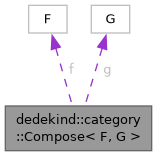
Collaboration diagram for dedekind::category::Compose< F, G >:
Public Types | |
| using | Domain = Dom<F> |
| using | Codomain = Cod<G> |
Public Member Functions | |
| constexpr bool | operator== (const Compose &) const =default |
Equal when the legs are (Arrows). | |
|
template<typename X> requires Presents<X, Domain> && requires(const F& f_, const G& g_, const X& x_) { g_(f_(x_)); } | |
| constexpr auto | operator() (const X &x) const |
Run the pipeline morphism__Objects_And_Their_Presentations): two arrows between objects presented by many types compose like any other. Where the result converts to the codomain's value type it is returned as that type, as before. | |
Public Attributes | |
| F | f |
| G | g |
Detailed Description
template<IsArrow F, IsArrow G>
requires std::same_as<Cod<F>, Dom<G>>
struct dedekind::category::Compose< F, G >
requires std::same_as<Cod<F>, Dom<G>>
struct dedekind::category::Compose< F, G >
The reified composition arrow g∘f: "apply @c F, then @c G" (diagrammatic f≫g order), the arrow-algebra companion to Identity.
Where Identity is the unit, Compose is the binary that makes composition a first-class type. It is what operator>> returns (f≫g = Compose<F,G>{f,g}); the previous lambda-wrapped arrow<A,C> erased the operand types, whereas Compose keeps F,G in the result type, so it is an IsArrow that downstream reasoning can pattern-match on. Two payoffs it unlocks (#908):
- Substitution
f*: the contravariant pullbackpreimage(f,P)isP∘f, i.e.Compose<F,P>— the general shape whose closed-form collapses (halfspace,:relational, ...) are the downstream fibres. - Variance composition:
:posetal registers the Horn clausesco∘co=coandanti∘anti=co(two flips cancel) onCompose, closing the one rule the variance logic program was missing.
The documentation for this struct was generated from the following file:
- src/main/modules/dedekind/category/morphism.cppm
