Equivalence relations: reflexive + symmetric + transitive predicates, composing the existing axiom traits in :species with a new symmetry trait.
More...
#include <concepts>#include <functional>#include <type_traits>#include <utility>import dedekind.category:mereology;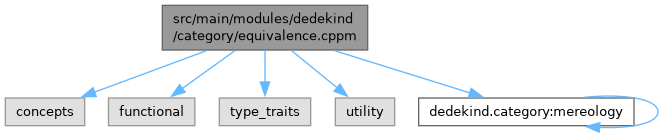
Namespaces | |
| namespace | dedekind::category |
Concepts | |
| concept | dedekind::category::IsSymmetric |
Formal verification: Rel(a, b) ⇔ Rel(b, a). | |
| concept | dedekind::category::IsEquality |
Rel on T is equality of values (the diagonal). | |
| concept | dedekind::category::IsChainDecidedSymmetric |
| Symmetry, stated once for every relation on a walkable chain. | |
| concept | dedekind::category::IsEquivalence |
A binary relation on T that is reflexive, symmetric, and transitive — the textbook equivalence-relation axioms. | |
| concept | dedekind::category::IsHashFunction |
A callable h on T whose codomain is std::size_t — i.e. an arrow T → size_t. | |
Functions | |
|
template<typename Rel, typename T> requires requires(const Rel& r, const T& x) { { r(x, x) } -> std::convertible_to<bool>; } | |
| constexpr bool | dedekind::category::symmetric_at (const Rel &rel, const T &a, const T &b) |
Symmetry at a point (mereology__The_Laws_At_A_Point). | |
|
template<typename Rel, typename T> requires requires(const Rel& r, const T& x) { { r(x, x) } -> std::convertible_to<bool>; { successor(x) } -> std::convertible_to<T>; } | |
| constexpr bool | dedekind::category::symmetric_on (const Rel &rel, const T &lo, const T &hi) |
Symmetry over a whole chain (mereology__The_Laws_On_A_Chain). | |
|
template<typename Rel, typename T> requires requires(const Rel& r, const T& x) { { r(x, x) } -> std::convertible_to<bool>; { x == x } -> std::convertible_to<bool>; } | |
| constexpr bool | dedekind::category::equality_at (const Rel &rel, const T &a, const T &b) |
Equality at a point: the relation answers as == does. | |
Variables | |
| template<typename T, typename Rel> | |
| constexpr bool | dedekind::category::is_symmetric_v = is_symmetric<T, Rel>::value |
The "v" helper following the | |
| template<typename T, typename Rel> | |
| constexpr bool | dedekind::category::is_equality_v = is_equality<T, Rel>::value |
Detailed Description
Equivalence relations: reflexive + symmetric + transitive predicates, composing the existing axiom traits in :species with a new symmetry trait.
@partition :equivalence
- Copyright
- 2026 The Dedekind Authors Licensed under the Apache License, Version 2.0.
equivalence__Motivation
The textbook equivalence relation R on a carrier T is reflexive (R(x, x)), symmetric (R(x, y) ⇔ R(y, x)), and transitive (R(x, y) ∧ R(y, z) ⇒ R(x, z)). These three properties are universal-property territory: the type system can name the predicate shape (a binary relation on T returning a logical value), but cannot quantify over all x, y, z to verify the axioms. Per the project's honesty obligation pattern, each axiom is an engineer-supplied trait specialisation; the compiler trusts the declaration; the public review process is the audit trail.
Reflexivity and transitivity already live in :species (is_reflexive_v<T, Rel> and is_transitive_v<T, Rel>, with the canonical specialisations on std::less_equal that the partial-order machinery in :posetal builds on). This partition adds the missing symmetry trait and bundles all three into a single IsEquivalence<T, Rel> concept.
equivalence__The_Mazur_Reading
Per Barry Mazur's When is one thing equal to some other thing? (in Gold & Simons (eds.), Proof and Other Dilemmas, MAA 2008), an equivalence relation is the principled way to relax strict equality without abandoning the algebraic gate: a carrier T can be treated as inhabiting a stricter algebraic concept when the laws hold up to a named equivalence relation, even if they don't hold under == in the bit-perfect sense. This partition lays the structural foundation for that escape hatch (filed under #591); the first concrete pilot is std::unsigned_integral as ℕ for ``sufficiently small'' inputs, wired in numbers:uint.
equivalence__Use_cases
- Bounded equivalence:
uint64_tunder modular arithmetic equates toℕfor inputs strictly less than2^64; the equivalence captures the ``sufficiently small'' qualification at the type level. Pilot innumbers:uint. - ε-equivalence on IEEE doubles:
|a-b|<eps; liftsdouble'snon-strict-field arithmetic into the algebraic gate. Future work; depends on the unsigned pilot landing first. - Quotient algebras:
A/~as a carrier requires the equivalence relation~onAthat defines the quotient (sister motivation toIsQuotientAlgebrainalgebra:quotient).
- See also
- Mazur, B. (2008), When is one thing equal to some other thing?, in Gold & Simons (eds.), Proof and Other Dilemmas: Mathematics and Philosophy, MAA, pp. 221–242.
- Note
- "No entity without identity." — Willard Van Orman Quine, Theories and Things (Harvard University Press, 1981), Ch. "Things and Their Place in Theories".
