Thin categories — categories whose hom-sets contain at most one morphism. More...
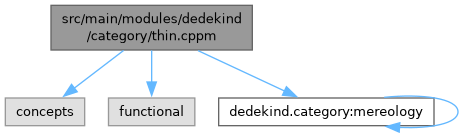
Namespaces | |
| namespace | dedekind::category |
Concepts | |
| concept | dedekind::category::IsThinCategory |
| A category in which every hom-set has at most one morphism. | |
Detailed Description
Thin categories — categories whose hom-sets contain at most one morphism.
@partition :thin
thin__Categorical_Definition
A thin (or posetal-shaped, in the textbook's looser usage) category is one in which hom(a, b) has at most one morphism for any pair of objects. Equivalently: any two parallel morphisms are equal.
In the order-theoretic encoding the codebase uses across :mereology and :posetal, this corresponds to a preorder over T with relation Rel and truth-value codomain L::Ω:
- Objects are elements of
T. - The unique morphism
a→ b (when it exists) is the witness ofRel(a,b)=L::True. - Identity morphism
id_acorresponds to reflexivity (Rel(a,a)=L::True). - Composition corresponds to transitivity (
Rel(a,b)∧Rel(b,c)⇒Rel(a,c)).
thin__Distinction_from_Posetal
IsThinCategory does not require antisymmetry. A thin category is a preorder, not necessarily a partial order; isomorphic objects need not be identical. Adding antisymmetry yields :posetal::IsPosetal — a thin category that is also skeletal.
IsPosetal is a strict refinement of IsThinCategory. At the time of this partition's introduction the inclusion is not yet encoded definitionally in IsPosetal — that signature-level refactor lands in #698 Slice 1, after which the inclusion is visible directly in IsPosetal's requires clause per the project's "faithful
specialization in the type signature from day 1" posture.
thin__Sollbruchstelle_From_Small
:small's docstring deliberately defers thin-category vocabulary: "thin, discrete, locally-finite, intensional / extensional, lazy /
strict — are also intentionally out of scope here; they are named
(or named-able) at downstream partitions where they have semantic
content." This partition closes that seam directly.
thin__Boolean_Witness
bool with std::less_equal participates: the 2-element poset (false ≤ true) is the smallest non-trivial thin category and a canonical entry point to the Form-chain (#698).
- Copyright
- 2026 The Dedekind Authors Licensed under the Apache License, Version 2.0.
- Note
- "Two parallel arrows in a thin category are equal --- the relation IS the morphism."
