Loading...
Searching...
No Matches
dedekind::sequences::𝔸< T, L, C > Struct Template Referencefinal
module dedekind.sequences
The universal set over the carrier T: the terminal object ⊤ of Sub(T), the reified type constraint.
More...
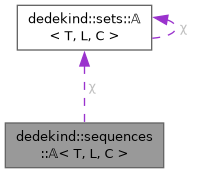
Collaboration diagram for dedekind::sequences::𝔸< T, L, C >:
Classes | |
| struct | Member |
| Member-shape mirror of Subobject's: every element of T is a member of U via the always-True classifier; the wrapper carries the T-value the IsSubobject contract reads back through ι. More... | |
Public Types | |
| using | Domain = T |
| The carrier: 𝔸 is the subobject \(T \hookrightarrow T\). | |
| using | Codomain = typename L::Ω |
The classifier's truth object L::Ω. | |
| using | cardinality_type = C |
The cardinality class of the carrier (Finite for bool, ℵ_0 by default; see default_cardinality_t). | |
| using | base_set_type = 𝔸<T, L, C> |
| using | is_universal_boundary = void |
Tag read by the boundary-object dispatch (Ø carries its dual). | |
| using | logic_species = L |
The logic species L the classifier is valued in. | |
| using | is_terminal_object_tag = void |
𝔸 is the terminal object of the subobject poset Sub(U): the top ⊤, classified by the always-true predicate χ_U ≡ ⊤, with the unique arrow S → U from every subobject. Dual to Ø's initiality tag; opts U into IsTerminalObject (the tag-discovery branch | |
Public Member Functions | |
| constexpr T | ι (const Member &m) const |
| ι: U ↣ T — the canonical identity inclusion. Every member of the universal set is by construction an element of the ambient T; ι unwraps the Member's T-value. | |
| constexpr auto | operator! () const |
The duality ¬⊤ = ⊥: the complement of the universe is Ø. | |
| constexpr L::Ω | operator<= (const 𝔸 &) const |
| constexpr bool | operator== (const 𝔸 &) const |
| Two universes over one carrier are equal (the type is the set). | |
|
template<typename L2, typename C2> requires (!std::same_as<L2, L> || !std::same_as<C2, C>) | |
| constexpr bool | operator== (const 𝔸< T, L2, C2 > &) const |
Cross-(L, C) identity: the universe of a carrier T is the universe regardless of logic species or cardinality annotation, so 𝔸<T>{} == r holds when a complement-pair join elevates r to an 𝔸<T,L2,C2> — the same spirit as Ø's cross-carrier equality. | |
| constexpr L::Ω | operator() (const T &) const |
The axiom of total presence: χ(x) = ⊤ for every x. | |
|
template<typename D = T> requires IsPairing<D> | |
| constexpr L::Ω | operator() (const leg_1_t< D > &, const leg_2_t< D > &) const |
χ on the components: over a product carrier the universe is the full relation, r(a, b) = r(⟨a, b⟩) (#1047). | |
| constexpr L::Ω | contains (const T &v) const |
Membership as a named query: 𝔸<T>{}.contains(v) reads more directly than 𝔸<T>{}(v) at listing sites. Returns L::Ω so the contract matches sets::Set::contains. | |
| constexpr cardinality_type | cardinality () const |
The cardinality class as a value (Finite / ℵ_0 tag). | |
| template<HasSetComplement S> | |
| constexpr auto | operator^ (const S &s) const |
Symmetric difference with the universe is complement: \(\top \,\triangle\, S = \neg S\) (every x is in ⊤, so it is in exactly one of the two iff it is not in S). ~ is the SET complement (a set object, found by ADL at instantiation); ! would be the predicate complement, an arrow. | |
Static Public Attributes | |
| static const 𝔸 | χ |
| The characteristic map is the set itself (χ ≡ ⊤). | |
| template<typename Op> | |
| static constexpr bool | is_associative_v |
| template<typename Op> | |
| static constexpr bool | is_idempotent_v |
Friends | |
| template<typename S> requires (!requires { typename S::T; }) && (!requires { typename S::is_variable; }) | |
| constexpr L::Ω | operator<= (const S &, const 𝔸 &) |
Detailed Description
template<typename T, IsOckhamAlgebra L = Boole, IsCardinality C = default_cardinality_t<T>>
struct dedekind::sequences::𝔸< T, L, C >
struct dedekind::sequences::𝔸< T, L, C >
The universal set over the carrier T: the terminal object ⊤ of Sub(T), the reified type constraint.
Intentional but decidable: the rule "x ∈ 𝔸" always returns True. The topos-theoretic reading is direct: 𝔸 is the universal (top) set over carrier T; the subobject classifier is L::Ω. One name for the type and the value, symmetric with Ø: the value spelling is 𝔸<T>{} (paper Listing 6 reads auto 𝔹 = 𝔸<bool>{}), the type spelling 𝔸<T> (so IsSetObject<𝔸<T>>, no decltype).
- Template Parameters
-
T the carrier (unconstrained on purpose: a non-regular carrier makes IsLSet/IsSetfalse rather than the name ill-formed).L the logic species the classifier is valued in ( IsOckhamAlgebra).C the cardinality class ( IsCardinality); defaults to default_cardinality_t.
Member Function Documentation
◆ operator<=()
template<typename T, IsOckhamAlgebra L = Boole, IsCardinality C = default_cardinality_t<T>>
|
inlineconstexpr |
Friends And Related Symbol Documentation
◆ operator<=
template<typename T, IsOckhamAlgebra L = Boole, IsCardinality C = default_cardinality_t<T>>
template<typename S>
requires (!requires { typename S::T; }) && (!requires { typename S::is_variable; })
requires (!requires { typename S::T; }) && (!requires { typename S::is_variable; })
|
friend |
boundaries__Lattice_Axiom_2
Everything is a part of the universe 𝔸. Constraint: Exclude Variables (which have a member T) to let symbolic expressions handle their own comparisons.
Member Data Documentation
◆ is_associative_v
template<typename T, IsOckhamAlgebra L = Boole, IsCardinality C = default_cardinality_t<T>>
template<typename Op>
|
staticconstexpr |
◆ is_idempotent_v
template<typename T, IsOckhamAlgebra L = Boole, IsCardinality C = default_cardinality_t<T>>
template<typename Op>
|
staticconstexpr |
Initial value:
=
std::is_same_v<Op, std::bit_and<base_set_type>> ||
std::is_same_v<Op, std::bit_or<base_set_type>>
The documentation for this struct was generated from the following file:
- src/main/modules/dedekind/sets/boundaries.cppm
