Loading...
Searching...
No Matches
dedekind::relational::Comprehension< Base, Predicate > Struct Template Reference
module dedekind.relational
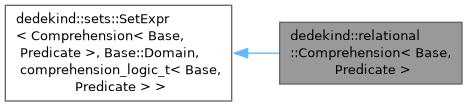
Inheritance diagram for dedekind::relational::Comprehension< Base, Predicate >:
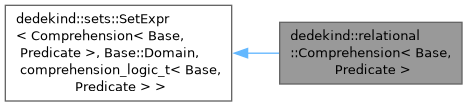
Collaboration diagram for dedekind::relational::Comprehension< Base, Predicate >:
Public Types | |
| using | cardinality_type = typename datum_cardinality<Predicate, Base>::type |
| Public Types inherited from dedekind::sets::SetExpr< Comprehension< Base, Predicate >, Base::Domain, comprehension_logic_t< Base, Predicate > > | |
| using | Domain |
| using | Codomain |
| using | logic_species |
Public Member Functions | |
| constexpr | Comprehension (const Base &b, Predicate p) |
Explicit two-argument constructor. Needed because SetExpr is a base class, so Comprehension is no longer an aggregate — the Comprehension{base, pred} sites (e.g. Singleton::operator|) route here instead of through aggregate init. | |
| constexpr | Comprehension (Predicate p) |
The former over the universe of the carrier: {x ∈ 𝔸 | P} from the predicate alone (the base is default-constructible, as 𝔸<T,L> is). This is the one set former of the Δ₀ core, Comprehension<𝔸<T,L>, P>. | |
| constexpr cardinality_type | cardinality () const |
| constexpr auto | operator() (const typename Base::Domain &x) const |
χ: the comprehension's characteristic map — x ∈ {S P} ⟺ x ∈ S ∧ P(x). A comprehension is a set, so it is its own predicate (IsSet ⟹ IsPredicate). | |
|
template<typename D = typename Base::Domain> requires IsPairing<D> | |
| constexpr auto | operator() (const leg_1_t< D > &a, const leg_2_t< D > &b) const |
χ on the components of a product carrier: a comprehension over A × B is a binary relation, and r(a, b) is r(⟨a, b⟩), the two presentations of one arrow by the product's universal property, \(\mathrm{Hom}(A\times B, \Omega) \cong
\mathrm{Multi}((A, B), \Omega)\) (#1047). | |
| template<typename U> requires (!std::same_as<std::remove_cvref_t<U>, typename Base::Domain>) && requires { requires Predicate::template admits<U>; } && (Is𝔸<Base> || std::invocable<const Base&, const U&>) | |
| constexpr auto | operator() (const U &x) const |
Heterogeneous χ: a value of a type U the datum declares it admits (Predicate::admits) is asked unnarrowed, so Singleton<int>{1}(1.5) is False. The universe is not asked (χ_𝔸 ≡ ⊤); a proper base must itself admit U. | |
| constexpr std::size_t | size () const |
Size when the datum carries it and the base is the whole universe: the point {p} over 𝔸<T> has size 1. | |
| constexpr std::size_t | upper_bound () const |
The ETCS cardinality bound a datum-sized comprehension exposes to bound_meet / bound_join: its exact size. | |
| Public Member Functions inherited from dedekind::sets::SetExpr< Comprehension< Base, Predicate >, Base::Domain, comprehension_logic_t< Base, Predicate > > | |
| constexpr Base::Domain | ι (const Member &m) const |
Public Attributes | |
| Base | base |
| Predicate | predicate |
Member Function Documentation
◆ operator()()
template<typename Base, typename Predicate>
template<typename U>
requires (!std::same_as<std::remove_cvref_t<U>, typename Base::Domain>) && requires { requires Predicate::template admits<U>; } && (Is𝔸<Base> || std::invocable<const Base&, const U&>)
requires (!std::same_as<std::remove_cvref_t<U>, typename Base::Domain>) && requires { requires Predicate::template admits<U>; } && (Is𝔸<Base> || std::invocable<const Base&, const U&>)
|
inlineconstexpr |
Heterogeneous χ: a value of a type U the datum declares it admits (Predicate::admits) is asked unnarrowed, so Singleton<int>{1}(1.5) is False. The universe is not asked (χ_𝔸 ≡ ⊤); a proper base must itself admit U.
- Template Parameters
-
U the foreign carrier.
The documentation for this struct was generated from the following file:
- src/main/modules/dedekind/sets/expressions.cppm
