A convex subset of a chain as a VALUE — an interval: each side an optional Bound, with a runtime-evaluable membership χ. Closed under ∩; a union or a complement leaves it unless one operand covers the other. No side is the universe; both sides closed at one value is a point; no Span at all is the one empty set, to which crossing bounds normalise. The bounds ride as values, never as NTTPs. Consume it through &, |, ==, <=, membership and the half / point / empty / universe / bounded factories.
More...
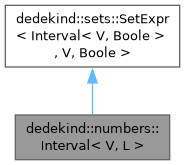
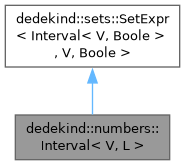
Public Types | |
| using | Domain = V |
| using | Codomain = typename L::Ω |
| using | cardinality_type = carrier_cardinality_t<V> |
| Public Types inherited from dedekind::sets::SetExpr< Interval< V, Boole >, V, Boole > | |
| using | Domain |
| using | Codomain |
| using | logic_species |
Public Member Functions | |
| constexpr | Interval ()=default |
| The universe, 𝔸. | |
| constexpr const std::optional< Span< V > > & | span () const |
The sides, or nullopt for Ø: a convex set is 1 + Span. Built only through the factories below, so always in normal form. | |
| constexpr bool | contains (const V &x) const |
| χ(x): runtime membership, decided from the value fields. | |
| constexpr bool | contains_bounded (const V &x) const |
| The sides' comparisons against the carrier. | |
| constexpr L::Ω | operator() (const V &x) const |
ETCS χ: contains lifted to the logic species L. | |
| Public Member Functions inherited from dedekind::sets::SetExpr< Interval< V, Boole >, V, Boole > | |
| constexpr V | ι (const Member &m) const |
Static Public Member Functions | |
| static constexpr Interval | half (V pivot, Direction d, Strictness s) |
The ray {x ⋈ pivot}. Whether it is empty, or all of the carrier, at the carrier's end is read by == Ø / == 𝔸. | |
| static constexpr Interval | point (V pivot) |
| static constexpr Interval | empty () |
The two boundary sets as values — the meet's annihilator (Ø) and unit (𝔸). Factories (not raw aggregate init) so callers never spell the empty-base brace of the SetExpr aggregate. | |
| static constexpr Interval | universe () |
| static constexpr Interval | bounded (V lo, Strictness sl, V hi, Strictness su) |
The bounded meet HasNNOStep: successor / predecessor, an axiom of the category), so the ℕ proxy Cardinality collapses to its point exactly as a machine integer does. | |
| static constexpr Interval | of_sides (const std::optional< Bound< V > > &lo, const std::optional< Bound< V > > &hi) |
The set with the given sides: through bounded when both are present, so it is collapsed. | |
Detailed Description
requires IsTotallyOrdered<V> && IsOckhamAlgebra<L>
struct dedekind::numbers::Interval< V, L >
A convex subset of a chain as a VALUE — an interval: each side an optional Bound, with a runtime-evaluable membership χ. Closed under ∩; a union or a complement leaves it unless one operand covers the other. No side is the universe; both sides closed at one value is a point; no Span at all is the one empty set, to which crossing bounds normalise. The bounds ride as values, never as NTTPs. Consume it through &, |, ==, <=, membership and the half / point / empty / universe / bounded factories.
The carrier is gated on the registered chain (IsTotallyOrdered): a cut is a normal form only on a chain.
- Template Parameters
-
V the carrier. L the species.
Member Function Documentation
◆ contains()
|
inlineconstexpr |
χ(x): runtime membership, decided from the value fields.
The two DECIDED cases (⊥ / ⊤) need no carrier comparison, so they are answered in this small front and the carrier comparisons live in contains_bounded behind it. The split is load-bearing for the IR exhibits: on a variant carrier (ℕ = Cardinality) the comparisons are heavy enough that the inliner declines a single fat function, and a constant Interval then stays a call instead of folding to ret i1 false. A small front inlines, the loads from the constant fold, and the bounded call is dead code.
◆ of_sides()
|
inlinestaticconstexpr |
The set with the given sides: through bounded when both are present, so it is collapsed.
- Parameters
-
lo the lower side. hi the upper side.
The documentation for this struct was generated from the following file:
- src/main/modules/dedekind/order/halfspace.cppm
