Loading...
Searching...
No Matches
dedekind::linear_algebra::OuterProduct< U, V, Mult > Struct Template Referenceexport
module dedekind.linear_algebra
Rank-1 matrix M = u][j] ⊗ v withM[i= u(i) product taken in a semiring.
More...⊗ thev(j),
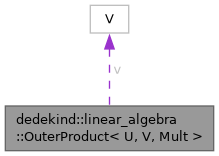
Collaboration diagram for dedekind::linear_algebra::OuterProduct< U, V, Mult >:
Public Member Functions | |
|
template<typename I, typename J> requires dedekind::order::IsDirectedSet<I> && dedekind::order::IsDirectedSet<J> && std::convertible_to<I, row_domain_type> && std::convertible_to<J, col_domain_type> | |
| constexpr scalar_type | operator() (I const &i, J const &j) const |
Entry j) = u(i) · v(j). Each axis is intensional in its factor's Domain — the row index runs in U::Domain, the column index in V::Domain (the two can differ). | |
Public Attributes | |
| U | u |
| V | v |
Detailed Description
template<typename U, typename V, typename Mult = std::multiplies<typename std::remove_cvref_t<U>::Codomain>>
requires dedekind::category::IsArrow<U> && dedekind::category::IsArrow<V>
struct dedekind::linear_algebra::OuterProduct< U, V, Mult >
requires dedekind::category::IsArrow<U> && dedekind::category::IsArrow<V>
struct dedekind::linear_algebra::OuterProduct< U, V, Mult >
Rank-1 matrix M = u][j] ⊗ v withM[i= u(i) product taken in a semiring. ⊗ thev(j),
diagonal__OuterProduct_Carrier
- Template Parameters
-
U Left factor ( IsArrowwithsize_tdomain).V Right factor ( IsArrowwithsize_tdomain, same scalar codomain asU).Mult The scalar product functor ⊗. Defaults tostd::multiplies(the ring·, so every existing call site and witness is unchanged), but any semiring⊗is admissible — passdedekind::algebra::semiring_ops<T>::multto build a tropical dyad (⊗=+), which the:transfer partition folds into the bra·ket eigenvalue. This is the sole hook that lets a max-plus carrier — which has no C++operator*— be a rank-1 matrix entry type.
Stored intensionally — neither factor needs to be dense-materialised. Either or both factors may be infinite-dimensional intensional sequences (e.g. dedekind::sequences::Path<T>); the outer product itself carries no dense m ×.n storage
The documentation for this struct was generated from the following file:
- src/main/modules/dedekind/linear_algebra/diagonal.cppm
