Loading...
Searching...
No Matches
dedekind::linear_algebra::Diagonal< D, F > Struct Template Referenceexport
module dedekind.linear_algebra
Diagonal matrix carrier M: D dimension × inD → T parametricD and diagonal rule F.
More...
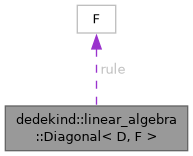
Collaboration diagram for dedekind::linear_algebra::Diagonal< D, F >:
Public Types | |
| using | scalar_type = typename std::remove_cvref_t<F>::Codomain |
| using | rule_domain_type = typename std::remove_cvref_t<F>::Domain |
| using | dimension_type = D |
Public Member Functions | |
| template<typename Idx> requires dedekind::order::IsDirectedSet<Idx> && std::convertible_to<Idx, rule_domain_type> | |
| constexpr scalar_type | at (Idx const &i) const |
Diagonal entry at row = col = i. | |
|
template<typename I, typename J> requires dedekind::order::IsDirectedSet<I> && dedekind::order::IsDirectedSet<J> && std::convertible_to<I, rule_domain_type> && std::convertible_to<J, rule_domain_type> | |
| constexpr scalar_type | operator() (I const &i, J const &j) const |
Matrix entry = δ_ij · F(i). Returns T{} off-diagonal. Equality of indices is decided after conversion to the rule's Domain — both I and J need only be net-domain-convertible to it. | |
Public Attributes | |
| F | rule |
Static Public Attributes | |
| static constexpr bool | is_finite = D::is_finite |
Detailed Description
template<typename D, typename F>
requires IsDimension<D> && dedekind::category::IsArrow<F>
struct dedekind::linear_algebra::Diagonal< D, F >
requires IsDimension<D> && dedekind::category::IsArrow<F>
struct dedekind::linear_algebra::Diagonal< D, F >
Diagonal matrix carrier M: D dimension × inD → T parametricD and diagonal rule F.
diagonal__Diagonal_Carrier
- Template Parameters
-
D Dimension witness ( dim_finite<N>orℵ<N>).F Diagonal rule, an IsArrowwithDomain=size_tand scalarCodomain.
Stored intensionally — the rule F is the carrier; the dense D is never materialised. Works uniformly at any × tableD entryD, including ℵ_0. Off-diagonal entries are T{} (the additive zero), per the δ_ij convention.
- Note
- Relational incarnation: a
Diagonalis the matrix reading of a Trsk coreflexivededekind::relational::diag(S)— the partial identity \(\Delta_S = \{(x,x)\mid x\in S\}\). The diagonal ruleFis exactlyS'scharacteristic function (over the logic semiring𝔹), soDiagonal<D, χ_S>≅diag(S)andIdentity<D>≅the full diagonaldiag(𝔸) (DiagPred). Both are point-free (rule, not table): the same partial-identity operator on the linear-algebra and relational surfaces. FIXME(#873): the concretecoreflexive↔Diagonalbridge.
Member Function Documentation
◆ at()
template<typename D, typename F>
template<typename Idx>
requires dedekind::order::IsDirectedSet<Idx> && std::convertible_to<Idx, rule_domain_type>
requires dedekind::order::IsDirectedSet<Idx> && std::convertible_to<Idx, rule_domain_type>
|
inlineconstexpr |
Diagonal entry at row = col = i.
Idx is parametric over any IsDirectedSet that converts to the rule's Domain — keeps the eval surface intensional in the index theory (the rule decides what kind of net domain it dispatches on; std::size_t is one inhabitant, ℕ another).
The documentation for this struct was generated from the following file:
- src/main/modules/dedekind/linear_algebra/diagonal.cppm
