Loading...
Searching...
No Matches
dedekind::category::Meet< A, B > Struct Template Referenceexport
module dedekind.category
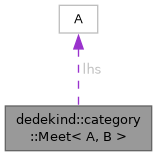
Collaboration diagram for dedekind::category::Meet< A, B >:
Public Member Functions | |
| template<typename... X> requires requires(const A& l, const B& r, const X&... x) { l(x...); r(x...); } | |
| constexpr auto | operator() (const X &... x) const |
Evaluate the meet at x, through the π_1 / π_2 accessors (operand storage touched in one place). With a logic_species the combination is that logic's AND (honouring Kleene / Heyting Ω); for plain bool-returning callables (comprehension lambdas) it is the bare &&. | |
Public Attributes | |
| A | lhs |
| B | rhs |
Member Function Documentation
◆ operator()()
template<typename A, typename B>
template<typename... X>
requires requires(const A& l, const B& r, const X&... x) { l(x...); r(x...); }
requires requires(const A& l, const B& r, const X&... x) { l(x...); r(x...); }
|
inlineconstexpr |
Evaluate the meet at x, through the π_1 / π_2 accessors (operand storage touched in one place). With a logic_species the combination is that logic's AND (honouring Kleene / Heyting Ω); for plain bool-returning callables (comprehension lambdas) it is the bare &&.
- Note
- LAYERING: the node stays LATTICE ALGEBRA only; the Set-specific subobject lift (
Member/ι/IsSet) lives DOWNSTREAM insets. -
The
logic_speciesbranch feeds operand results straight toL::AND, so it assumes operands return the RAWL::Ω. The:sets surface always does (membership islift_logic<L>, which yieldsL::Ω, never aTruth<L>wrapper), so this is sound there. A callable whose codomain isTruth<L>would need unwrapping first; that path is not reached throughsets.
The documentation for this struct was generated from the following file:
- src/main/modules/dedekind/category/lattice.cppm
