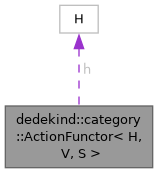
A right action as a functor out of the delooping of the monoid it acts by: the one object to V, an element s to \(v \mapsto h(v,
s)\). Its functor laws are the action's, \(h(v, 1) = v\) and \(h(h(v, a), b) = h(v, a \cdot b)\), which acting_monoid declares, so they are derived and not declared again. A left action registers the opposite operation, so it is a functor out of the opposite category.
More...
Public Types | |
| using | Op = typename acting_monoid<H>::type |
| using | Σ_cat = Delooping<S, Op> |
| using | Τ_cat = ActingOn<H, V, S> |
| using | Domain = Σ_cat |
| using | Codomain = Τ_cat |
| template<typename U> | |
| using | Shape = V |
Public Member Functions | |
| constexpr Codomain | operator() (const Domain &) const |
| constexpr Acting< H, V, S > | operator() (const Element< S, Op > &s) const |
| constexpr IdentityIn< Τ_cat > | operator() (const IdentityIn< Σ_cat > &) const |
| The identity to the identity: the functor's unit law, at the type. | |
Public Attributes | |
| H | h {} |
Detailed Description
requires IsRightAction<H, V, S>
struct dedekind::category::ActionFunctor< H, V, S >
A right action as a functor out of the delooping of the monoid it acts by: the one object to V, an element s to \(v \mapsto h(v,
s)\). Its functor laws are the action's, \(h(v, 1) = v\) and \(h(h(v, a), b) = h(v, a \cdot b)\), which acting_monoid declares, so they are derived and not declared again. A left action registers the opposite operation, so it is a functor out of the opposite category.
- Template Parameters
-
H the action. V what it acts on. S the monoid's carrier.
The documentation for this struct was generated from the following file:
- src/main/modules/dedekind/category/functor.cppm
