Loading...
Searching...
No Matches
approx.cppm File Reference
module dedekind.numbers.approx
Compatibility bridge for IEEE approximation policies. More...
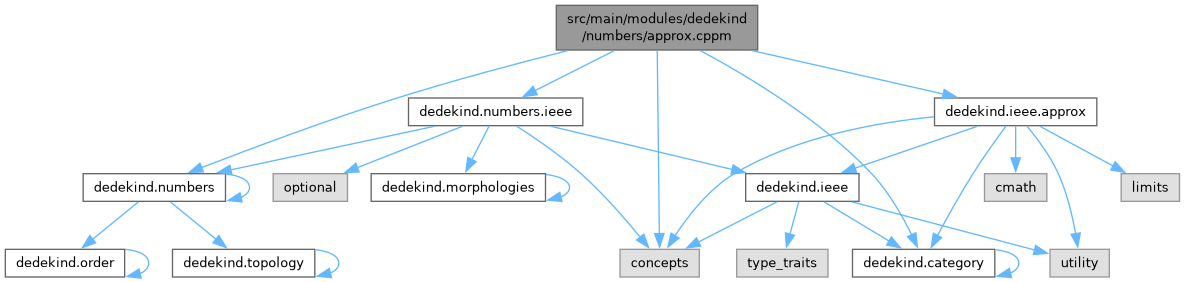
#include <concepts>import dedekind.numbers.ieee;import dedekind.numbers;import dedekind.ieee.approx;import dedekind.category;
Include dependency graph for approx.cppm:
Namespaces | |
| namespace | dedekind::numbers |
Concepts | |
| concept | dedekind::numbers::IsIEEEPropagationOp |
Typedefs | |
| template<std::floating_point F = machine_real_scalar> | |
| using | dedekind::numbers::Approx = dedekind::ieee::Approx<F> |
| template<std::floating_point F = machine_real_scalar> | |
| using | dedekind::numbers::ReportErrorPolicy = dedekind::ieee::ReportErrorPolicy<F> |
| template<std::floating_point F = machine_real_scalar> | |
| using | dedekind::numbers::IgnoreErrorPolicy = dedekind::ieee::IgnoreErrorPolicy<F> |
| template<std::floating_point F = machine_real_scalar> | |
| using | dedekind::numbers::AdaptiveErrorPolicy = dedekind::ieee::AdaptiveErrorPolicy<F> |
Enumerations | |
| enum class | dedekind::numbers::NumericRegion |
| Region tags for simple runtime numeric diagnostics. | |
Functions | |
| template<std::floating_point F = machine_real_scalar> | |
| constexpr NumericRegion | dedekind::numbers::classify_region (F x, F near_zero_scale=F{64}, F huge_scale=F{0.5}) noexcept |
| template<std::floating_point F = machine_real_scalar> | |
| constexpr F | dedekind::numbers::roundoff_proxy (F x) noexcept |
|
template<std::floating_point F, typename Op> requires IsIEEEPropagationOp<Op, F> | |
| constexpr Approx< F > | dedekind::numbers::propagate (const Approx< F > &a, const Approx< F > &b, const Op &op={}) noexcept |
| Propagate approximation error through a binary IEEE operation. | |
| template<std::floating_point F = double> | |
| constexpr Approx< F > | dedekind::numbers::demo_propagate_add (const Approx< F > &a, const Approx< F > &b) noexcept |
| Demo: propagate error through IEEE addition. | |
| template<std::floating_point F = double> | |
| constexpr Approx< F > | dedekind::numbers::demo_propagate_mul (const Approx< F > &a, const Approx< F > &b) noexcept |
| Demo: propagate error through IEEE multiplication. | |
| template<std::floating_point F = double> | |
| constexpr IEEE< F > | dedekind::numbers::demo_add_ignore (const IEEE< F > &a, const IEEE< F > &b) noexcept |
| template<std::floating_point F = double> | |
| constexpr Approx< F > | dedekind::numbers::demo_add_report (const IEEE< F > &a, const IEEE< F > &b) noexcept |
| Demo operation: IEEE add under report policy. | |
| template<std::floating_point F = double> | |
| constexpr TernaryResult< Approx< F > > | dedekind::numbers::demo_add_adaptive (const IEEE< F > &a, const IEEE< F > &b) noexcept |
| Demo operation: IEEE add under adaptive policy. | |
Detailed Description
Compatibility bridge for IEEE approximation policies.
- Copyright
- 2026 The Dedekind Authors Licensed under the Apache License, Version 2.0.
- Note
- "Lorsque les valeurs successivement attribuees a une meme variable s'approchent indefiniment d'une valeur fixe, de maniere a finir par en differer aussi peu qu'on voudra, cette derniere est appelee la limite de toutes les autres." ("When the values successively assigned to the same variable approach a fixed value indefinitely, so as to differ from it by as little as one wishes, this latter is called the limit of all the others.") – Augustin-Louis Cauchy, Cours d'Analyse (1821)
