Cyclic and Archimedean morphology carriers. More...

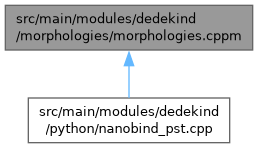
Go to the source code of this file.
Detailed Description
Cyclic and Archimedean morphology carriers.
morphologies__The_Structural_Seal
« La mathématique est l'étude des structures qui sont invariantes par certains changements de forme. La morphologie est la saisie de cette stabilité. » (Mathematics is the study of structures that are invariant under certain changes of form. Morphology is the grasping of this stability.) — René Thom, 'Stabilité structurelle et morphogénèse'
morphologies__Partitions
:archimedean —IsCyclic,IsCyclicRing,IsSimplyInfinite,IsArchimedeanField,IsDedekindCompleteField, plus theCauchyPathcarrier. (Sequence-side conceptsIsCauchySequenceandIsConvergentSequencemoved to:sequences::convergence under the textbook factoring; #719 Slice 0.) Hosts thesuccessor/generatorvocabulary notes (carrier-level member API ↔ axiomaticorder::IsSuccessor; modern copula-theoretic Archimedean-generator bridge).:cyclic — the concrete cyclic carriersModular<N>( \(\mathbb{Z}/N\mathbb{Z}\) as a finite cyclic ring) andCyclicRing<T,N>. Both expose the operationalIsCyclicshape;Modular<N>is additionally registered with the axiomaticcategory::IsCyclicGroup<T, std::plus<T>>.
morphologies__Taxonomic_Intent
While :algebra defines the internal harmony of a species, :morphologies defines the valid mappings (Arrows) between distinct species and the carriers that exhibit canonical morphological structure (cyclic, Archimedean, Cauchy). It establishes the criteria for "Sameness" (Isomorphism) and "Structure Preservation" (Homomorphism) across the Dedekind universe.
- See also
- dedekind.category:total — the axiomatic side (
IsCyclicGroup,IsAbelianGroup,IsCommutativeRing). - dedekind.algebra:field — the field-level concept counterpart.
- Copyright
- 2026 The Dedekind Authors Licensed under the Apache License, Version 2.0.
- Note
- "Mathematics knows no races or geographic boundaries; for mathematics, the cultural world is one country." – David Hilbert, quoted in Mathematical Circles Revisited (1971)
