Image-as-coequalizer-of-kernel-pair: IsImageOf<S, F> on the mono side and IsCoequalizer<Q, F, G> on the quotient side.
More...
#include <concepts>#include <optional>#include <type_traits>#include <utility>import dedekind.category:logic;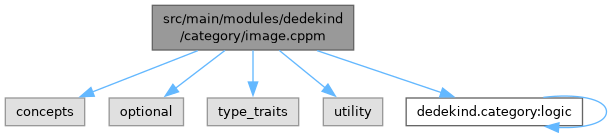
Classes | |
| struct | dedekind::category::ImageChi< F > |
The characteristic predicate of image_of(F) — recognises y as "in the image of @c F". More... | |
| struct | dedekind::category::ImageChi< F > |
Image classifier for a retractable arrow: y is in the image iff the retract fires at y. More... | |
| struct | dedekind::category::image_decidability_witness::ToyRetract |
| struct | dedekind::category::image_decidability_witness::ToyEmbed |
| struct | dedekind::category::image_decidability_witness::ToyGeneral |
| struct | dedekind::category::kernel_quotient< F > |
| Opt-in trait: textbook claim "for this @c F, @c A/ker(F)
is the carrier @c ::Class". More... | |
| struct | dedekind::category::image_carrier< F > |
| Opt-in trait: textbook claim "for this @c F, @c im(F)
is the carrier @c ::type". More... | |
Namespaces | |
| namespace | dedekind::category |
Concepts | |
| concept | dedekind::category::IsImageOf |
S realises the image of arrow F as a Subobject of Cod<F> — the mono side of the (regular epi, mono) factorisation system pinned in | |
| concept | dedekind::category::IsCoequalizer |
The categorical dual of IsEqualizer — a Quotient of Cod<F> equating two parallel arrows F, G. | |
| concept | dedekind::category::WitnessesFirstIso |
Connector witnesses the First Isomorphism Theorem at homomorphism F. | |
Functions | |
| template<typename F> requires IsArrow<F> && std::constructible_from<std::remove_cvref_t<F>, F&&> | |
| constexpr auto | dedekind::category::image_of (F f) |
Factory: image_of(f) constructs the image of f as a Subobject of Cod<F>. | |
| constexpr ToyRetract | dedekind::category::image_decidability_witness::retract (ToyEmbed) |
Variables | |
| template<typename A> | |
| constexpr bool | dedekind::category::is_exact_category_v< CanonicalSetCCC< A > > = true |
| template<> | |
| constexpr bool | dedekind::category::is_monic_arrow_v< image_decidability_witness::ToyEmbed > |
Detailed Description
Image-as-coequalizer-of-kernel-pair: IsImageOf<S, F> on the mono side and IsCoequalizer<Q, F, G> on the quotient side.
@partition :image
- Copyright
- 2026 The Dedekind Authors Licensed under the Apache License, Version 2.0.
image__Motivation
Hosts the canonical epi-mono factorisation chain set up by :pullback (kernel pair, parallel pair) and :topoi (subobject, quotient):
IsKernelPair → IsParallelPair → IsCoequalizer → IsImageOf
For an arrow F : A → B, the image Im(F) is the coequalizer of the kernel pair of F:
\(\mathrm{Im}(F) \) \(=\) \(\mathrm{coeq}(\pi_1, \pi_2 : \mathrm{KernelPair}(F) \rightrightarrows A)\).
Equivalently (in a topos) the image is the smallest subobject of B through which F factors, giving the canonical epi-mono factorisation F = m ∘ e:
A → Im(F) → B
with e regular-epi (the coequalizer projection) and m mono (the inclusion of the image into the codomain). Two structurally named concepts pin the two sides:
- mono side:
IsImageOf<S, F>—Sis a Subobject ofCod<F>realising the image. - quotient side:
IsCoequalizer<Q, F, G>—Qis a Quotient ofCod<F>equating the parallel pairF,G.
Both are co-located here in :image since the image-as-coequalizer reading is the structural payoff that ties them together. The universal-property obligations (smallest such subobject, canonical factorisation, regular-epi universality of q) remain the engineer's honesty obligation in the IsNNO style.
image__Structural_vs_Universal
What IsImageOf can pin (structural shape):
Fis an arrow (IsArrow<F>),Sis a Subobject ofCod<F>(IsSubobject<S,Cod<F>>).
What IsImageOf cannot pin (engineer's honesty obligation, as for IsNNO):
- That
Sis the smallest such subobject (universality of the image factorisation), - That
Ffactors throughSasm∘ewitheregular-epi andmmono, - That the factorisation is unique up to isomorphism.
C++ concepts cannot quantify over the universal property's $\forall$; they can only pin operational signatures. The naming here is the structural anchor — a downstream carrier witness declares IsImageOf<MyImageSet, MyArrow> to record the intent that its subobject realises the image. The audit (that this is in fact the smallest containing subobject) lives in the witness's documentation and review.
image__Realisation_Regimes
The §3 paper outline (Functions on Sets: Filtering and
Transforming) names three realisation regimes for the abstract image, each pinned by IsImageOf with a different S:
- Extensional (finite carriers):
Sis a concrete std-container subobject realised by iteration insets:extensional(image(f,std::unordered_set<T>) etc.). - Intensional (NNO-domain transforms):
Sis the orbit closure of an iterated step, naturally pinnable onPath<T>insequences:path(categorical-anchor breadcrumbs land in the follow-up slice). - Symbolic (Tier C, future):
Sis a deferred set expression under an inhabitancy DSL (#603), evaluated lazily.
image__Layering
Upstream-of-everything-numeric. Lives in :category alongside :pullback; carrier witnesses register downstream where the carriers are available ( sets:extensional for std-container carriers; sequences:path for the NNO-morphism reading).
- Note
- "ἁρμονία δὲ πολυμιγέων ἕνωσις καὶ δίχα φρονεόντων συμφρόνησις." ("Harmony is the unification of things many-mixed, and the same-mindedness of things thinking-apart.") — Philolaus of Croton, fragment B10 DK, apud Stobaeus, Anthology I.21.7d.
