The left fold (catamorphism) over an enumerable sequence. More...
#include <algorithm>#include <utility>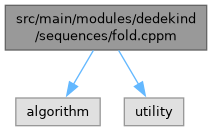
Functions | |
| template<typename Range, typename Acc, typename Op> | |
| constexpr Acc | dedekind::sequences::fold (const Range &xs, Acc acc, Op op) |
Strict left fold over an enumerable range xs. | |
Detailed Description
The left fold (catamorphism) over an enumerable sequence.
@partition :fold
- Copyright
- 2026 The Dedekind Authors Licensed under the Apache License, Version 2.0.
fold__Overview
fold(xs, init, op) reduces a sequence to a single value by threading an accumulator, op(acc, x) left to right. It is the point-free primitive behind the graph closure of dedekind.optimization:closure — a graph algorithm becomes a fold over its edge sequence rather than nested index loops. A fold is defined only for an enumerable (extensional) sequence: an intensional predicate has no elements to thread (Rice), so its relation is materialised extensionally first, then folded.
Function Documentation
◆ fold()
|
constexprexport |
Strict left fold over an enumerable range xs.
Threads the accumulator through op(acc, x) left to right and returns it. A scalar accumulator recovers the familiar reduction (sum, product); a structured accumulator (a potential vector) a stateful pass.
The step is a function of the accumulator and the element, acc = op(acc, x): the textbook \(\mathrm{fold}(\oplus, e)\), with no effect on anything but its result. The accumulator is moved into the step and moved out, so a cheaply movable accumulator costs nothing per step; a fixed-capacity array (the closure's potential net) is copied by its move, which is the honest price of a fold that is a fold.
- Parameters
-
xs any range with begin/end(e.g. aconstexprarray, which folds to a constant at translation time).acc the seed accumulator (returned, threaded). op op(acc, x): the new accumulator, applied left to right.
