Adjoint functors (the Free / Forgetful axis). More...
#include <concepts>#include <functional>#include <type_traits>#include <utility>import dedekind.category:logic;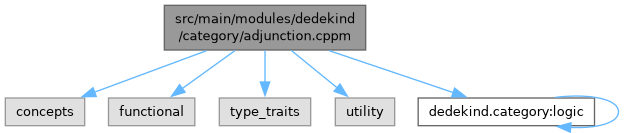
Classes | |
| struct | dedekind::category::adjunction_witness< Left, Right, Unit, Counit > |
| Typed unit/counit data for an adjunction witness. More... | |
| struct | dedekind::category::is_adjoint< F, G, Op > |
The adjunction law \(f(x) \le y \iff x \le g(y)\) as an opt-in leaf fact, with the one theorem derived here: a monotone isomorphism is adjoint to its inverse ( \(f(x) \le y \iff x \le f^{-1}(y)\), both legs monotone). Other adjunctions register their fact where their theorem is stated (Δ ⊣ ∧ per glb in S ⊣ P on the saturating ℤ in numbers:integer, the antitone involution's self-adjunction in algebra:ordered_algebra). More... | |
Namespaces | |
| namespace | dedekind::category |
Concepts | |
| concept | dedekind::category::HasAdjunctionShape |
Structural shape: F and U have the categorical signature of an adjoint pair F ⊣ U — F : 𝒟 → 𝒞 (left, free) and U : 𝒞 → 𝒟 (right, forgetful). | |
| concept | dedekind::category::IsFreeFunctor |
Directional alias: F is the left adjoint of an adjunction F ⊣ U. Names the free direction — F sends an object d : 𝒟 to its free construction F(d) : 𝒞 (the universal recipient under U). | |
| concept | dedekind::category::IsForgetfulFunctor |
Directional alias: U is the right adjoint of an adjunction F ⊣ U. Names the forgetful direction — U drops the structure that distinguishes 𝒞 from 𝒟 (e.g., U_Ring→Rig forgets that you can do −). | |
| concept | dedekind::category::IsUnitOfAdjunction |
Structural shape: η is the unit of an adjunction F ⊣ U — a natural transformation id_𝒟 ⇒ U ∘ F. | |
| concept | dedekind::category::IsCounitOfAdjunction |
Structural shape: ε is the counit of an adjunction F ⊣ U — a natural transformation F ∘ U ⇒ id_𝒞. Dual of IsUnitOfAdjunction. | |
| concept | dedekind::category::IsAdjunction |
| A typed unit/counit witness relating a left and right functor. | |
| concept | dedekind::category::IsCovariantFunctor |
A covariant functor between posetal categories: an order-PRESERVING arrow. This is IsMonotone read categorically (a monotone map is a functor of posets that preserves the direction of composition), the documented covariant pole of functor variance (#908). | |
| concept | dedekind::category::IsContravariantFunctor |
A contravariant functor between posetal categories: an order-REVERSING arrow (IsAntiMonotone read categorically). The contravariant pole; inhabited by the negation NegationArrow ¬ and any Compose that mixes one covariant with one contravariant leg. | |
| concept | dedekind::category::IsVariantFunctor |
A functor between posetal categories with a definite variance: covariant or contravariant. This is the "@c IsFunctor parametrized
with @c IsVariant" umbrella whose poles are IsCovariantFunctor and IsContravariantFunctor, and exactly the leg-shape a Galois connection's adjoints must share (matched variance, below). | |
| concept | dedekind::category::IsOrderEmbedding |
An order-preserving embedding: a monic, order-preserving arrow of one ordered set into another. Such an embedding is a covariant functor between the two posetal categories, so IsCovariantFunctor is a conjunct — the classification is derived from the two legs (IsEmbeddingFunctor && IsMonotone), not re-declared per carrier (#908). | |
| concept | dedekind::category::IsGaloisConnection |
Structural shape: F and G form a Galois connection F ⊣ G in a posetal setting — the simplest adjunction. Both are monotone arrows; F : P → Q and G : Q → P with the source/target carriers crossed (so F's Codomain matches G's Domain and vice versa). The universal-property test, for monotone legs | |
| concept | dedekind::category::IsClosureOperator |
Structural shape: C is a closure operator on a poset P — an arrow C : P → P that is idempotent (C(C(x)) = C(x)), monotone (x ≤ y ⇒ C(x) ≤ C(y)), and extensive (x ≤ C(x)) for all x. | |
Functions | |
|
template<typename Left, typename Right, typename Unit, typename Counit> requires IsAdjunction<std::remove_cvref_t<Left>, std::remove_cvref_t<Right>, std::remove_cvref_t<Unit>, std::remove_cvref_t<Counit>> | |
| constexpr auto | dedekind::category::make_adjunction (Left left, Right right, Unit unit, Counit counit) |
| Factory for adjunction witnesses. | |
Variables | |
| template<typename F, typename G, typename Op = std::less_equal<>> | |
| constexpr bool | dedekind::category::is_adjoint_v = is_adjoint<F, G, Op>::value |
| template<typename F, typename G, typename Op> | |
| constexpr bool | dedekind::category::is_adjoint_v< F, G, Op > = true |
Detailed Description
Adjoint functors (the Free / Forgetful axis).
@partition :adjunction
- Copyright
- 2026 The Dedekind Authors Licensed under the Apache License, Version 2.0.
adjunction__Adjunctions
An adjunction F ⊣ U is a pair of functors F : 𝒟 → 𝒞 (the free / left adjoint) and U : 𝒞 → 𝒟 (the forgetful / right adjoint), with a natural isomorphism Hom_𝒞(F(d), c) ≅ Hom_𝒟(d, U(c)) between the two hom-sets. Equivalently: a unit η : id_𝒟 ⇒ U ∘ F and a counit ε : F ∘ U ⇒ id_𝒞 satisfying the triangle identities (Mac Lane Ch. IV; Pierce gives adjunctions their own section because the structure recurs everywhere a free construction does).
adjunction__In_this_codebase
Concrete carrier-side instances:
F:Rig→Ring(the Grothendieck construction):SignedCardinality=F(Cardinality),Cardinality=U(SignedCardinality).F:IntegralDomain→Field(the field of fractions):Rational<Z>=F(Z)forZ=SignedExtensionalCardinal<>.F:OrderedField→CompleteOrderedField(the Cauchy completion):Real=F(Rational).F:Field→AlgebraicallyClosedField(the algebraic closure):Complex=F(Real).
Each step in the carrier lattice ℕ ⊂ ℤ ⊂ ℚ ⊂ ℝ ⊂ ℂ is a free construction in its respective category. The closure-forcing operators (-Cardinality → SignedCardinality, etc.) are the unit's components made operational at the operator level — see docs/design/carrier-lattice.md.
adjunction__Two_concept_tiers
The partition exposes two conceptually distinct surfaces:
HasAdjunctionShape<F,U>— structural-only 2-parameter form. Names just the categorical signatures of the adjoint pair; the unit / counit are unspecified. Used in the directional aliasesIsFreeFunctor/IsForgetfulFunctorwhere the directional reading is what's load-bearing.
IsAdjunction<Left,Right,Unit,Counit>— stronger 4-parameter witness form. Requires explicit unit and counit arrows and exercises the typed triangle-identity surface. Used where the actual unit / counit components are concretely available (e.g. for monad-style derivations).
The split mirrors a recurring project pattern: the 2-param shape concept (cheap, deducible) anchors the textbook vocabulary and gates downstream uses; the n-param witness concept binds the operational evidence.
- Note
- "Adjoint functors arise everywhere." — Saunders Mac Lane,
CategoriesfortheWorkingMathematician(1971), as quoted in Benjamin C. Pierce,BasicCategoryTheoryforComputerScientists(1991), §2.6.
